
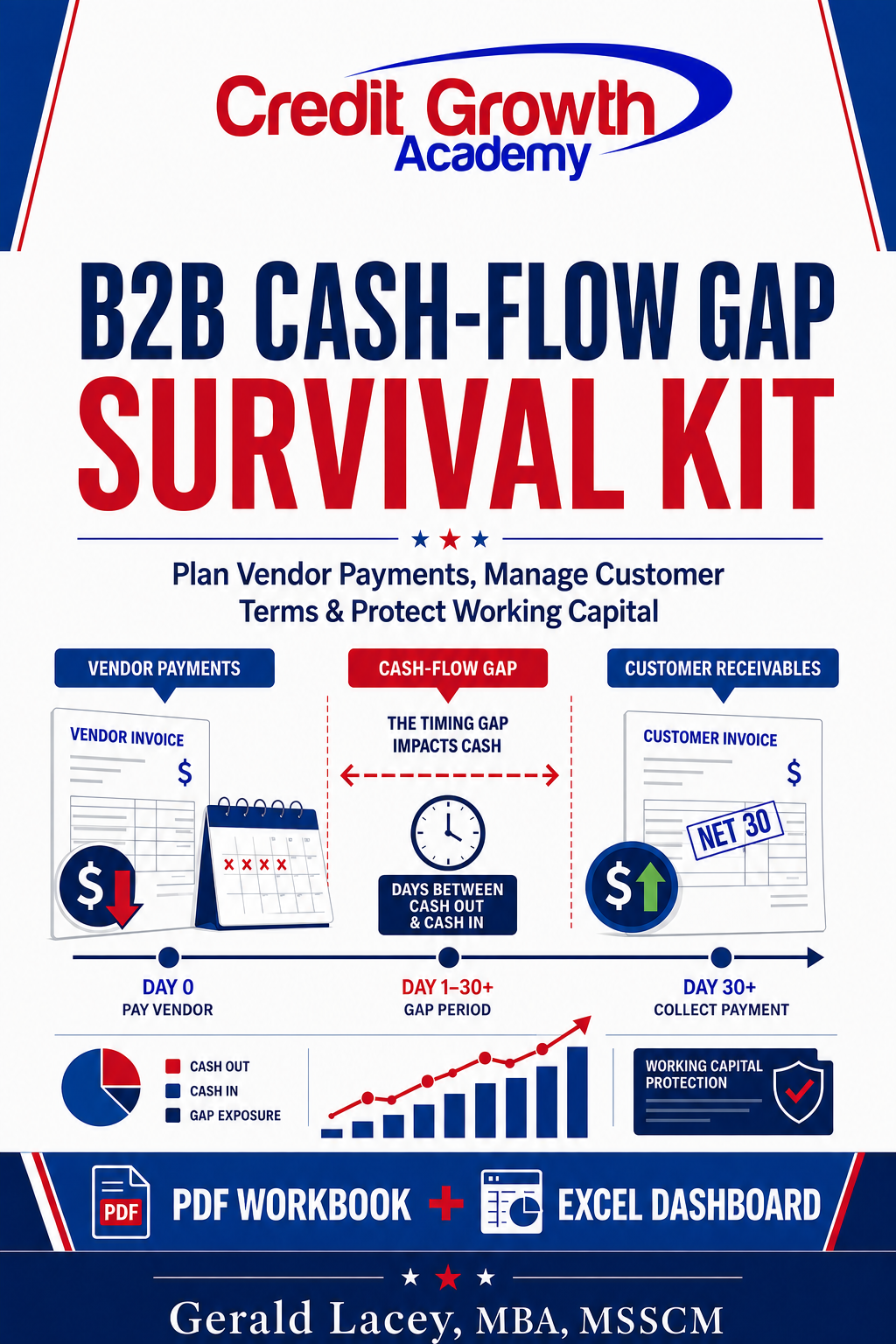
B2B Cash-Flow Gap Survival Kit
Plan Vendor Payments, Manage Customer Terms and Protect Working Capital
See the timing between paying vendors and collecting customer invoices before that gap creates unnecessary pressure on your business.
The CGA B2B Cash-Flow Gap Survival Kit combines a guided 17-page PDF workbook with an Excel dashboard to help B2B business owners organize vendor obligations, monitor customer receivables, forecast short-term cash flow and develop a practical working-capital action plan.
Digital Download | 17-Page PDF Workbook + Excel Dashboard
💳 Only $16.97
Instant digital access • No physical product • Microsoft Excel recommended
✓ Beginner-friendly
✓ Printable and digital PDF
✓ Instant download
✓ Practical worksheets included
💵 Profitable on Paper—But Pressured by Payment Timing?
A business can generate sales and still experience cash-flow pressure when vendor bills and operating expenses come due before customers pay their invoices.
A cash-flow timing gap may develop when:
- Vendors require payment before customers pay
- Customers operate on Net 30, Net 60 or other delayed terms
- Payroll and operating expenses continue during the gap
- Customer payments arrive later than expected
- Several vendor obligations become due during the same period
- Short-term financing costs reduce available working capital
- Cash-flow information is scattered across invoices, calendars and spreadsheets
Basic income reports tell you what the business earned.
The CGA B2B Cash-Flow Gap Survival Kit helps you examine when cash is expected to enter and leave the business.
📊 See the Timing Behind Your Cash Flow
Use one coordinated planning system to organize and review:
- ✓ Expected cash inflows
- ✓ Upcoming cash outflows
- ✓ Vendor-payment amounts
- ✓ Vendor-payment due dates
- ✓ Customer invoice amounts
- ✓ Expected customer-payment dates
- ✓ Accounts-receivable timing
- ✓ Weekly projected cash position
- ✓ Potential cash-flow gap periods
- ✓ Vendor and customer payment terms
- ✓ Potential funding costs
- ✓ Working-capital priorities
- ✓ Corrective actions and next steps
The goal is not to predict the future perfectly.
The goal is to build a clearer, more organized view of the information available today.
🧭 Make More Informed Cash-Flow Decisions
Use your business information to explore important questions.
📅 When could a cash-flow gap develop?
Compare expected customer payments with upcoming vendor obligations and operating expenses.
🧾 Which vendor payments are approaching?
Organize payment dates, amounts and priority obligations in one planning system.
💰 When are customer payments expected?
Track customer invoices, expected collection dates and payment status.
⏱️ How long is the timing gap?
Review the number of days between paying vendors and receiving customer payments.
⚖️ Which options deserve comparison?
Evaluate payment terms, collection priorities and potential funding costs before making a decision.
✅ What should happen next?
Document immediate priorities and create a focused working-capital action plan.
🧰 Everything Included in Your Survival Kit
Your purchase includes two coordinated digital files.
📘 17-Page PDF Action Workbook
Use the guided workbook to:
- Identify your cash-flow timing gap
- Map vendor-payment obligations
- Estimate customer-payment dates
- Review accounts-receivable timing
- Compare vendor and customer terms
- Consider potential funding alternatives
- Review potential funding costs
- Document cash-flow priorities
- Create a focused action plan
📊 Excel Cash-Flow Dashboard
Use the Excel planning tool to:
- Build a 13-week cash-flow forecast
- Track expected cash inflows
- Track upcoming cash outflows
- Organize vendor-payment dates
- Monitor expected customer receipts
- Estimate potential cash-flow gap exposure
- Review weekly cash-flow timing
- Compare payment-term information
- Organize working-capital considerations
- Record planned actions and follow-up items
🔄 Understand the Cash-Flow Timing Cycle
🔴 Day 0: Pay the Vendor
The business pays a vendor invoice or incurs another operating expense.
🕒 Day 1–30+: Manage the Gap Period
The business continues operating while waiting for customer invoices to be paid.
🔵 Day 30+: Collect the Customer Payment
The customer payment arrives and becomes available for business operations.
The length and impact of the gap depend on the accuracy of your information, customer behavior, vendor terms, operating expenses and other business circumstances.
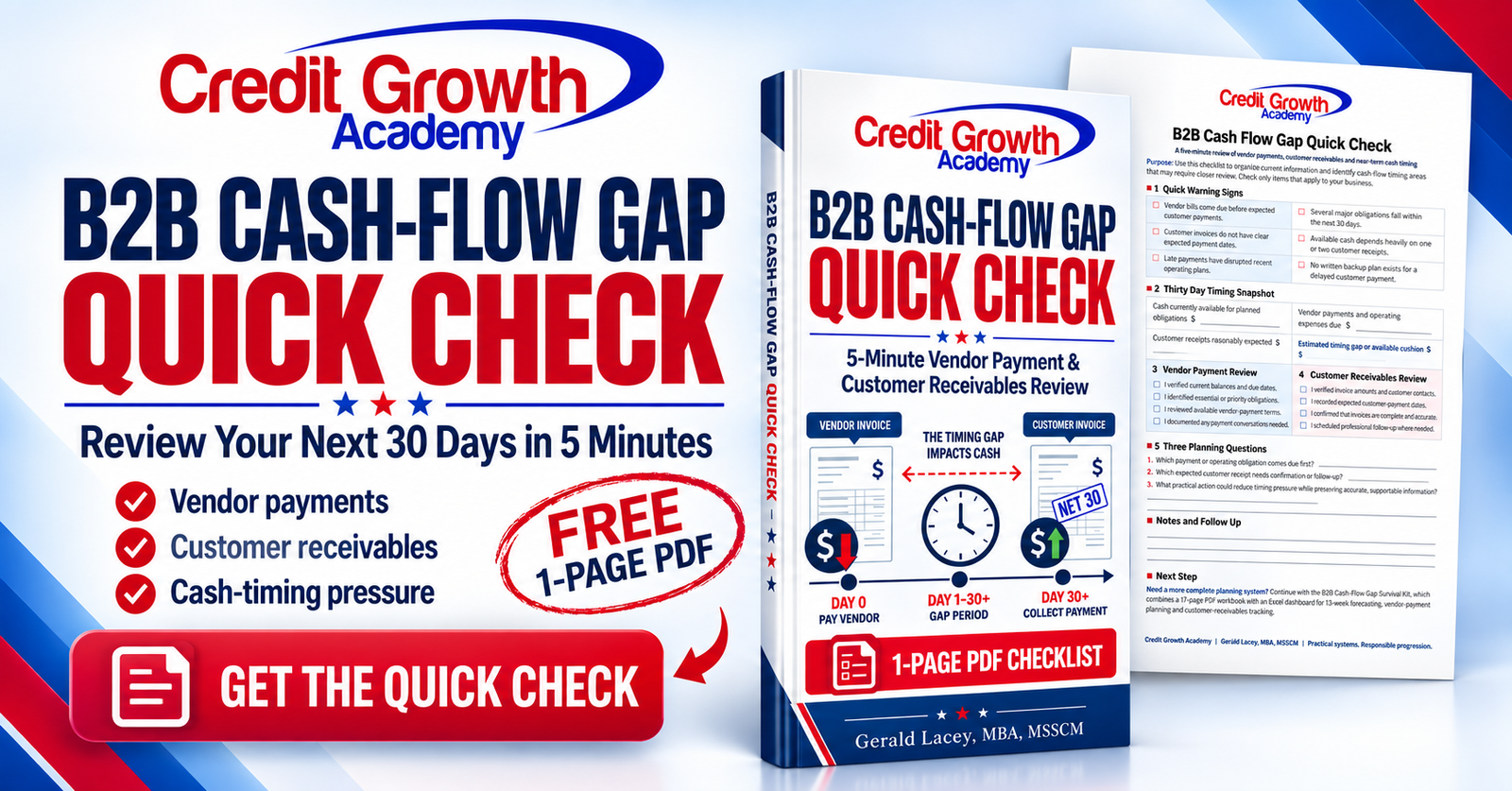
🎁 Free Bonus Resource
B2B Cash-Flow Gap Quick Check
The B2B Cash-Flow Gap Survival Kit combines a guided PDF workbook with an Excel dashboard for organizing vendor payments, customer receivables and short-term cash-flow timing.
By subscribing, you may also receive practical business-credit education, product updates, and special offers from Credit Growth Academy. You can unsubscribe at any time.
📈 Ready for a Complete Business-Credit System?
Business Credit Builder Starter System
The 7 Business Credit Mistakes to Avoid guide helps you identify what could go wrong.
The Business Credit Builder Starter System helps you organize what to do next.
Use the system to:
- Build a structured 30-day action plan
- Review business-credit readiness
- Organize vendor-account research
- Track applications and results
- Monitor invoice due dates
- Record payment activity
- Plan your next business-credit steps
Best for: Entrepreneurs who want a more complete system for organizing their business-credit journey.
EXPLORE THE BUSINESS CREDIT BUILDER STARTER SYSTEM
🔗 Related CGA Resources
Business Credit & Vendor Credit Starter Checklist
Start with the foundational steps for preparing your business for vendor and business-credit opportunities.
VIEW THE STARTER CHECKLIST
EIN Credit Accelerator
Learn what an EIN does, what it does not do, and how to strengthen the business profile surrounding it.
EXPLORE THE EIN CREDIT ACCELERATOR
Net 30/60/90 Business Credit Readiness Kit
Prepare for vendor terms, organize accounts, and track Net 30, Net 60, and Net 90 payment responsibilities.
VIEW THE NET TERMS READINESS KIT
🧭 Your CGA Business-Credit Path
Step 1: Review
Identify the seven mistakes that could affect your progress.
Step 2: Correct
Use the checklist and worksheet to address readiness gaps.
Step 3: Organize
Track applications, accounts, due dates, and results.
Step 4: Apply Strategically
Choose appropriate vendors or lenders and apply with a clear purpose.
Step 5: Monitor
Review every result and adjust your strategy before applying again.
▶️ Watch the Product Overview
Learn what is included in the 7 Business Credit Mistakes to Avoid guide and how it can help you prepare before applying.
Review seven common business-credit mistakes and discover how this practical CGA guide can help you prepare, organize, and apply more strategically.
❓ Frequently Asked Questions
Is this guide suitable for beginners?
Yes. It is written for entrepreneurs and small-business owners who are beginning to explore vendor credit, business credit, or business funding.
Will this guide guarantee business-credit approval?
No. Vendors, lenders, and credit issuers establish their own requirements. The guide helps you identify mistakes and improve your preparation, but it cannot guarantee approval, reporting, funding, or a specific credit limit.
Is this a physical product?
No. This is a digital PDF product. Nothing will be shipped.
Can I print the guide?
Yes. You may print a copy for your personal or internal business use.
Can I complete it digitally?
Yes. The PDF can be reviewed digitally. Depending on your PDF software, you may also be able to add notes electronically.
Does an EIN automatically establish business credit?
No. An EIN identifies the business for tax and administrative purposes, but additional business-profile, account, payment, and reporting activity may be needed to establish a business-credit history.
Is this guide personalized financial or credit advice?
No. The resource provides general educational information and is not personalized legal, tax, accounting, lending, or financial advice.
Build Strong Credit. Grow Your Business.
A stronger business-credit process begins before the application is submitted.
Use the 7 Business Credit Mistakes to Avoid guide to review your readiness, correct preventable problems, and approach future applications with a more organized strategy.
One printable PDF • Practical worksheets • Instant digital download
Important Disclaimer
This resource is provided for general educational and organizational purposes only. It does not constitute legal, tax, accounting, credit-repair, lending, or financial advice.
Credit Growth Academy does not guarantee business-credit approvals, vendor approvals, credit limits, funding, reporting, score increases, or specific results. Vendor, lender, and business-credit reporting requirements can change. Customers should independently verify current requirements before applying or making financial decisions.
© Credit Growth Academy. All rights reserved.
Support
Questions or download issues?
📧 support@creditgrowthacademy.com
© Credit Growth Academy | All Rights Reserved
